Showing posts with label Preston Whiteway. Show all posts

Tuesday, September 20, 2011

ATCA Membership Could Help Grow Richmond Theatre

Posted by Bruce Miller
The American Theatre Critics Association is the national association of professional theatre critics. Its members work for newspapers, magazines, radio, television, and on-line services across the United States. Membership is open to all who "review theatre professionally, regularly and with substance for print, electronic or digital media."

ATCA was founded in 1974 by a group of leading theater critics from around the country. The prevailing wisdom at the time was that the New York Drama Critics Circle was too geographically limiting to meet the growing national need. Daumier’s 1865 cricature, “La Promenade du Critique Influent,” (pictured to the left) has been ATCA’s self-deprecatory logo since its founding.

Prior to 1974, the founding critics had been gathering informally for several years at the Eugene O’Neill Theater Center in Waterford, CT, where Phil Whiteway's nephew, Preston Whiteway (pictured below and to the right), has served as Executive Director since 2007. ATCA’s connection to the O’Neill continues today in the annual National Critics Institute, which many US theatre critics attend as fellows and mentors.

Since its founding, ATCA has provided opportunities for members to explore the remarkable artistic resources of our national theatre. ATCA works to foster greater communication among theatre critics in the United States, to improve the training and development of critics at different stages of their careers, to advocate absolute freedom of expression in theatre and theatre criticism, and to increase public awareness of the theatre as an important national resource.

In addition to the National Critics Institute at the O'Neill, ATCA offers valuable professional and networking opportunities through twice yearly conferences. In a typical year, members gather for a five-day annual conference in a major theatre center outside New York, as well as for a shorter meeting in New York or at some theater festival. In addition to seminars, guest speakers, discussions with regional and national theatre practitioners, and a sampling of the host region’s theatres, there’s ample opportunity to talk shop with others in the profession.

In addition to conferences and meetings, ATCA provides information through email and on its website about current trends in theatre, the ethical dilemmas critics face, and upcoming international seminars and workshops through the International Association of Theatre Critics, of which ATCA is the American affiliate.

ATCA members also join in supporting new plays. Each year ATCA presents several awards for new plays and emerging playwrights. Members make a recommendation to the American Theatre Wing for the Regional Theatre Tony Award (the theatre recommended by ATCA always wins) and vote on inductees to the Theater Hall of Fame.

Currently, the only Virginia critics listed as members on the ATCA website are Maggie Lawrence in Culpeper, Wendy Parker in Midlothian, and David Siegel in Annandale. In days gone by, Roy Proctor was not only a member of ATCA, he served as the association's national president.

As Richmond theatre continues to grow and improve, it would be great to have several Richmond critics join ATCA. Two years ago, Legacy of Light (two RTCCA nominees from Barksdale's production of Legacy are pictured to the left) was one of only three new plays in the US to receive Best of the Year recognition from ATCA after its world premiere at Arena Stage. Legacy received this recognition due in large part to the advocacy of several DC ATCA members. The previous year, Signature Theatre in Northern Virginia won the regional theatre Tony Award, also due to the efforts of the DC critics.

As early as this season, it is possible that a play receiving its world premiere in Richmond might have a shot at the invaluable national recognition awarded by the ATCA, but only if Richmond's critics join the association and participate in its voting. Ten or so years from now, it would be possible for a Richmond theatre to win the regional theatre Tony, (why not dream big, folks) but again, only if Central Virginia's critics join ATCA and serve as advocates for Richmond theatre. Also, it would be possible in the near future to bring the national conference of ATCA to Richmond, significantly advancing our national profile as a theatre city, but only if we have active local ATCA members.

Advancing Richmond as a national caliber theatre city could and I believe should be an important goal for all of us. Encouraging our wonderful critics to join ATCA may be one way to make progress toward this goal. Annual dues are $45, and if critics need help with that, I suspect it could be found.

--Bruce Miller

Monday, May 24, 2010

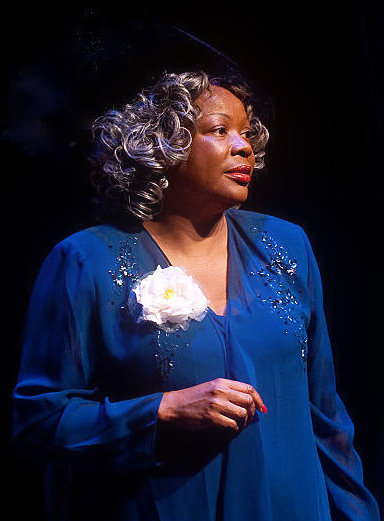
Regina Taylor, Author of "Crowns"

Posted by Bruce Miller
Our current production of Crowns is co-produced with African American Repertory Theatre, and directed and choreographed by Leslie Owens-Harrington. This entertaining and inspiring musical is written by acclaimed American actress, Regina Taylor.

Taylor is the sixth African American woman playwright whose work has been produced on the Barksdale and Theatre IV stages. Playing the Six Degrees of Separation game, it's interesting to discover the people (and themes) that connect us with this exemplary American theatre artist.

I first encountered and grew to admire Regina Taylor in the early 90s when she starred in the critically acclaimed TV series, I'll Fly Away. My friend (and Barksdale favorite) Joe Inscoe also appeared in that television classic, playing a Southern antagonist to Taylor's character.

Some of you may best know Taylor from her more recent TV series, The Unit. She played Molly Blane, wife of Sergeant Major Jonas Blane. Molly was the strong-willed homemaker who held all the military wives together when their fighting men were called away on active duty.

The Unit was created and executive produced by another great American playwright, David Mamet. Co-starring with Taylor in The Unit was Scott Foley, who played Sergeant First Class Bob Brown. Foley's brother-in-law is acclaimed stage and screen actor Patrick Wilson, whose father, John Wilson, starred in Barksdale's productions of The Fantasticks in 1963 and Generation in 1968.

Taylor was born in Dallas, Texas. When she was in the second grade, she moved with her mother to Muskogee, Oklahoma. Her mother was a Social Service Administration employee and transfers were common.

Having a professional mother provided inspiration to Taylor as she was growing up. "She taught me never to set limits on who I could be," Taylor states in People. "I developed an active imagination very young and was always writing plays and musicals."

Taylor's mother also encouraged a sustaining sense of pride and identity in her daughter. When she entered seventh grade, Taylor enrolled in a newly integrated school. On the first day of session, a white classmate sitting next to Taylor loudly informed the teacher, "I do not want to sit next to this nigger."

Taylor was shaken when she encountered this level of racial hatred for the first time. "I thought, 'How can she hate me when she doesn't know me?,'" Taylor states in People. Later she realized that this early encounter helped her to understand the racial prejudice to which her mother's generation had been subjected. In many ways, this understanding helped to prepare her for her career.

When the founders of Barksdale moved to Hanover from New York, they encountered for the first time the racial hatred exemplified by the Jim Crow Laws, which prohibited mixed-race audiences at any arts event. Facing possible arrest, Muriel McAuley and Pete Kilgore defiantly invited African American leaders from Virginia Union University to attend their plays in 1954, becoming the first arts organization in the state to do so. Not only did they break the law, they broke the back of that particular Jim Crow Law forever.

During her high school years, Taylor and her mother moved back to Dallas. After graduating from high school, she enrolled at Southern Methodist University. While still a student, she was cast in the 1980 TV series Nurse and 1981's made-for-television movie Crisis at Central High, playing Minnijean Brown, one of the nine black students who in 1957 risked everything to proactively effect history when they enrolled in the previously segregated Central High School in Little Rock, AR.

After college graduation, Taylor moved immediately to New York. Her big break came in 1986 when she was cast in an innovative project of the New York Shakespeare Festival - Joseph Papp, Producer. The project was called Shakespeare on Broadway for the Schools. Three Shakespearean masterworks were produced in rotating rep for reduced-price student performances: As You Like It, Macbeth, and Romeo and Juliet. John Moon, who directed Barksdale's just-closed production of Is He Dead?, was working in the casting department of the Shakespeare Festival at this time. Taylor was cast as Celia in As You Like It, the First Witch in Macbeth, and Juliet in Romeo and Juliet, becoming the first actress of color to play this iconic role on Broadway.

In 1989, Taylor received national attention for her role as the drug-addicted mother of a gifted student in the hit film Lean on Me. This led to her TV stardom playing Lilly Harper in I'll Fly Away, winning for Taylor two Emmy nominations, a Golden Globe Award for Best Actress in a Television Drama, and an NAACP Image Award for Outstanding Actress in a Drama Series.

Like many acts of great intention, I'll Fly Away was not without controversy. African American film studies scholar Mary Helen Washington argued that the show focused too much on the white characters (the family headed by Sam Waterston) and too little on the character of Lilly, her family and friends. "Isn't it ironic," Washington asked, "that black people, who produced, directed, cast, and starred in the original Civil Rights Movement have become minor players in its dramatic reenactment? Isn't it tragic that after all the protests, all the freedom songs, and all the marches against white domination, black images in media are still largely controlled by whites?"

Similar arguments have been, are currently, and will continue to be leveled against Barksdale whenever we offer to work in partnership with African American Repertory Theatre and/or choose to produce black theatre ourselves. Any nonprofit theatre that follows its heart has to learn to listen to and respect such criticism, while still continuing to do its best to work proactively for the community's good.

During the period when critics like Washington were questioning the focus of I'll Fly Away, Taylor herself said this in an interview with Essence: "In terms of fully exploring a female character, I believe I have the best television role for a woman, black or white."

Caitlin Collins, a Northwestern University student who worked with Taylor during a recent residency, stated the following: "One of the ideas Regina passed onto us, which will stick with me, is the notion that others may try to label you as one thing or another, to name you, but you have the power to name yourself and to follow your own inspiration."

Billy Siegenfeld, professor of dance at Northwestern, added: "Regina Taylor lives a fiercely open-minded creative life, one that constantly questions the received wisdoms about how one should behave as well as the habits of generalization that drive people to categorize each other unjustly."

In recent years, Taylor has also become one of America's most popular playwrights. Crowns was the most performed musical in the nation in 2006. Her most recent work, Magnolia, is set during the beginning of desegregation in Atlanta in 1961. The world premiere was presented at Chicago's Goodman Theatre last year, after a development workshop in 2008 at this year's Tony Award-winning National Playwright's Conference at the Eugene O'Neill Theater Center, where Phil Whiteway's nephew, Preston Whiteway, serves as Executive Director.

I hope you'll join me soon for our revival of Crowns. We're earning standing ovations at every performance, and the show is thrilling to watch, both as entertainment and inspiration.

--Bruce Miller

Photo Captions (starting at the top): The set and cast of Crowns, playwright and actress Regina Taylor, Shalimar Hickman Fields as Jeanette in Crowns, Margarette Joyner as Mother Shaw in Crowns, Preston Whiteway - Executive Director of the Eugene O'Neill Theater Center.

Wednesday, September 23, 2009

Random Ramblings on "Boleros"

Posted by Bruce Miller
I'm told by friends who heard the review on WCVE-FM yesterday afternoon that John Porter has written a glowing assess-ment of Boleros for the Disenchanted. This would be great. The show is getting amazing word-of-mouth, but it's a lesser known title. Every bit of positive PR helps. As of this morning, John's review is not posted on the WCVE-FM website. I'll let you know how to access a copy as soon as I can figure it out.

Two days from now, on Friday Sept 25 at 11 a.m., the cast of Boleros will assemble on our Willow Lawn stage for the first of two panel discussions: A Long Way from West Side Story - Being Latino in the USA Today. Two of our six actors are of Puerto Rican lineage, three have Mexican roots, and one is of Cuban ancestry. All are proud Latino Americans. I'll be moderating the discussion, and we'll be talking about the many gifts that their heritage has bestowed upon them. This panel discussion is one of the monthly meetings of our Bifocals Theatre Project. It is free and open to the public.

Immediately following the one hour discussion, we'll move to the lobby for a casual buffet lunch consisting of lunchmeats and cheeses, breads, lettuce and tomatoes, snack and dessert items, and beverages. A $5 free-will donation is suggested for lunch.

Jose Lorenzo, the Cuban balladeer who opens the show with his stirring rendition of the classic bolero Toda una vida, is also the artist who painted the beautiful and evocative landscapes on display in our lobby. More about Jose later.

We expanded our lobby stage by approximately 64 sq ft to create the Plaza Stage used as a performance space by the Latin Ballet during intermission of Boleros. Dance has been a central component of Hispanic and Latino theatre since its inception. In Hispanic tradition, the dancers are not confined to the stage of the theatre. The dances, always designed to reflect the themes of the play, frequently spill out into the audience and onto plaza stages constructed outside the theatres walls. Rather than invade the Willow Lawn parking lot, we’ve constructed our Plaza Stage inside. Audiences are enjoying this cultural exploration.

Simple platform plaza stages similar to ours have been growing in popularity over the last several years as the impact of Latino culture spreads nationally. You will find plaza stages in most major cities throughout the west, southwest and Florida. Perhaps the most well known plaza stages are the ones used by the Today Show for their summer music series, and the ones found at Disneyland in California and Universal in Orlando,

John Glenn, former artistic director of Barksdale, and R. L. Rowsey, former associate artistic director of TheatreVirginia, are in town to direct and music direct Souvenir, opening this Friday at Barksdale Theatre at Hanover Tavern. I was honored that both talented men were able to join us for opening night of Boleros. It was GREAT to have a few minutes to visit with these two friends, and to hear how much they enjoyed the show. For John, it was his first visit back to Barksdale since he left a dozen or so years ago.

Bernardo Cubria, the WONDERFUL Mexican American actor who plays Manuelo in Boleros and thrills audiences during two of the plays funniest scenes, is also a professional translator. It is his voice that can be heard speaking in Spanish on our pre-show announcement (along with Janine Serresseque, speaking in English). Bernardo is also creating the translation that will be used in October when we begin projecting the dialogue in Spanish super-titles onto the western wall of the theatre during selected performances.

Last tidbit—Michelle Guadalupe, the talented actress who charms as Petra, has now added a second “Whiteway” to her resume. Two summers ago, Michelle acted with the prestigious Eugene O’Neill Theatre Center in Connecticut. The Executive Director of the O’Neill is none other than Preston Whiteway, Phil’s super-achieving, 27/28-year-old nephew (pictured to the left). Those of you who knew Phil in his late 20s will note the strong family resemblance.

See you at the theatre!

--Bruce Miller