Showing posts with label race. Show all posts

Monday, May 24, 2010

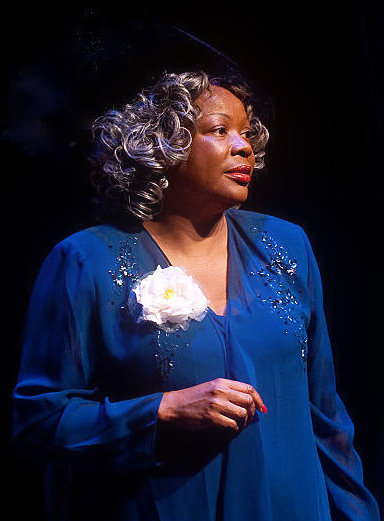
Regina Taylor, Author of "Crowns"

Posted by Bruce Miller
Our current production of Crowns is co-produced with African American Repertory Theatre, and directed and choreographed by Leslie Owens-Harrington. This entertaining and inspiring musical is written by acclaimed American actress, Regina Taylor.

Taylor is the sixth African American woman playwright whose work has been produced on the Barksdale and Theatre IV stages. Playing the Six Degrees of Separation game, it's interesting to discover the people (and themes) that connect us with this exemplary American theatre artist.

I first encountered and grew to admire Regina Taylor in the early 90s when she starred in the critically acclaimed TV series, I'll Fly Away. My friend (and Barksdale favorite) Joe Inscoe also appeared in that television classic, playing a Southern antagonist to Taylor's character.

Some of you may best know Taylor from her more recent TV series, The Unit. She played Molly Blane, wife of Sergeant Major Jonas Blane. Molly was the strong-willed homemaker who held all the military wives together when their fighting men were called away on active duty.

The Unit was created and executive produced by another great American playwright, David Mamet. Co-starring with Taylor in The Unit was Scott Foley, who played Sergeant First Class Bob Brown. Foley's brother-in-law is acclaimed stage and screen actor Patrick Wilson, whose father, John Wilson, starred in Barksdale's productions of The Fantasticks in 1963 and Generation in 1968.

Taylor was born in Dallas, Texas. When she was in the second grade, she moved with her mother to Muskogee, Oklahoma. Her mother was a Social Service Administration employee and transfers were common.

Having a professional mother provided inspiration to Taylor as she was growing up. "She taught me never to set limits on who I could be," Taylor states in People. "I developed an active imagination very young and was always writing plays and musicals."

Taylor's mother also encouraged a sustaining sense of pride and identity in her daughter. When she entered seventh grade, Taylor enrolled in a newly integrated school. On the first day of session, a white classmate sitting next to Taylor loudly informed the teacher, "I do not want to sit next to this nigger."

Taylor was shaken when she encountered this level of racial hatred for the first time. "I thought, 'How can she hate me when she doesn't know me?,'" Taylor states in People. Later she realized that this early encounter helped her to understand the racial prejudice to which her mother's generation had been subjected. In many ways, this understanding helped to prepare her for her career.

When the founders of Barksdale moved to Hanover from New York, they encountered for the first time the racial hatred exemplified by the Jim Crow Laws, which prohibited mixed-race audiences at any arts event. Facing possible arrest, Muriel McAuley and Pete Kilgore defiantly invited African American leaders from Virginia Union University to attend their plays in 1954, becoming the first arts organization in the state to do so. Not only did they break the law, they broke the back of that particular Jim Crow Law forever.

During her high school years, Taylor and her mother moved back to Dallas. After graduating from high school, she enrolled at Southern Methodist University. While still a student, she was cast in the 1980 TV series Nurse and 1981's made-for-television movie Crisis at Central High, playing Minnijean Brown, one of the nine black students who in 1957 risked everything to proactively effect history when they enrolled in the previously segregated Central High School in Little Rock, AR.

After college graduation, Taylor moved immediately to New York. Her big break came in 1986 when she was cast in an innovative project of the New York Shakespeare Festival - Joseph Papp, Producer. The project was called Shakespeare on Broadway for the Schools. Three Shakespearean masterworks were produced in rotating rep for reduced-price student performances: As You Like It, Macbeth, and Romeo and Juliet. John Moon, who directed Barksdale's just-closed production of Is He Dead?, was working in the casting department of the Shakespeare Festival at this time. Taylor was cast as Celia in As You Like It, the First Witch in Macbeth, and Juliet in Romeo and Juliet, becoming the first actress of color to play this iconic role on Broadway.

In 1989, Taylor received national attention for her role as the drug-addicted mother of a gifted student in the hit film Lean on Me. This led to her TV stardom playing Lilly Harper in I'll Fly Away, winning for Taylor two Emmy nominations, a Golden Globe Award for Best Actress in a Television Drama, and an NAACP Image Award for Outstanding Actress in a Drama Series.
Like many acts of great intention, I'll Fly Away was not without controversy. African American film studies scholar Mary Helen Washington argued that the show focused too much on the white characters (the family headed by Sam Waterston) and too little on the character of Lilly, her family and friends. "Isn't it ironic," Washington asked, "that black people, who produced, directed, cast, and starred in the original Civil Rights Movement have become minor players in its dramatic reenactment? Isn't it tragic that after all the protests, all the freedom songs, and all the marches against white domination, black images in media are still largely controlled by whites?"

Similar arguments have been, are currently, and will continue to be leveled against Barksdale whenever we offer to work in partnership with African American Repertory Theatre and/or choose to produce black theatre ourselves. Any nonprofit theatre that follows its heart has to learn to listen to and respect such criticism, while still continuing to do its best to work proactively for the community's good.

During the period when critics like Washington were questioning the focus of I'll Fly Away, Taylor herself said this in an interview with Essence: "In terms of fully exploring a female character, I believe I have the best television role for a woman, black or white."

Caitlin Collins, a Northwestern University student who worked with Taylor during a recent residency, stated the following: "One of the ideas Regina passed onto us, which will stick with me, is the notion that others may try to label you as one thing or another, to name you, but you have the power to name yourself and to follow your own inspiration."

Billy Siegenfeld, professor of dance at Northwestern, added: "Regina Taylor lives a fiercely open-minded creative life, one that constantly questions the received wisdoms about how one should behave as well as the habits of generalization that drive people to categorize each other unjustly."

In recent years, Taylor has also become one of America's most popular playwrights. Crowns was the most performed musical in the nation in 2006. Her most recent work, Magnolia, is set during the beginning of desegregation in Atlanta in 1961. The world premiere was presented at Chicago's Goodman Theatre last year, after a development workshop in 2008 at this year's Tony Award-winning National Playwright's Conference at the Eugene O'Neill Theater Center, where Phil Whiteway's nephew, Preston Whiteway, serves as Executive Director.

I hope you'll join me soon for our revival of Crowns. We're earning standing ovations at every performance, and the show is thrilling to watch, both as entertainment and inspiration.

--Bruce Miller

Photo Captions (starting at the top): The set and cast of Crowns, playwright and actress Regina Taylor, Shalimar Hickman Fields as Jeanette in Crowns, Margarette Joyner as Mother Shaw in Crowns, Preston Whiteway - Executive Director of the Eugene O'Neill Theater Center.

Saturday, February 2, 2008

Race - Parts III and IV: From Darwin to Ota Benga to the Barksdale Stage

Posted by Bruce Miller
Part III
There are those who believe that Barksdale doesn’t do enough to promote racial equity, and I hear from them on a regular basis. We’ll talk about those issues soon.

There are more people who write to me alleging that Barksdale does too much.

My first production as artistic director was the musical comedy They’re Playing Our Song (2001). Director Jan Guarino cast two African Americans among the three men and three women who function as the alter egos of the leads, played by Robyn O’Neill and Steve Perigard, both of whom are white. “If they’re supposed to be alter egos,” a frustrated patron wrote, “why make them black. Please don’t follow the path of the Theatre of Virginia and try to force political correctness down our throats.”
Similar objections were filed when Susan Sanford and Jerold Solomon appeared opposite each other in Olympus on my Mind (2002), when Jan Guarino and Billy Dye exchanged flirtations in Annie Get Your Gun (2003), when two racially mixed couples headed the cast of Where’s Charley? (2004), and when we cast black actors among Beauregard’s extended family in Mame (2006).

I recently heard from a man who was offended because “the colored girl” in Swingtime Canteen (my wonderfully talented friend Katrinah Lewis) asked a white man in the audience to dance with her. His comment centered on the fact that Swingtime was supposed to be a re-creation of a USO show from 1944, and that no “colored female during the war years would ask a white soldier to come on stage and dance with her.” Hopefully it shows how far things have come in the last few decades. When I cast Katrinah in the role, it never even occurred to me that anyone would object.

Sometimes offense is taken from the other direction. I heard from four women, three of whom I believe were African American, who were offended by the fact that Jill Bari Steinberg played all the black characters in Syringa Tree as well as all the white characters.

I don’t want to overstate the problem. For every person who is offended, there are thousands who love what they’re seeing on stage and cheer us on.

Barksdale has a commitment to colorblind casting. This is not in an effort to be “politically correct”; it is simply our policy to cast each show based on talent rather than race. For many people my age and younger, interracial romance is barely noticeable. What I’ve come to realize is that a lot of our older audience members were brought up in a world where being colorblind was not even an option.

In South Pacific, the great American lyricist Oscar Hammerstein II got it right when he caustically commented on how racial prejudice had become so pervasive in American society. “You’ve got to be taught,” he said, “to be afraid of people whose eyes are oddly made, of people whose skin is a different shade—you’ve got to be carefully taught.”

The eminent British naturalist Charles Darwin may be the father of evolutionary theory, but he is also, perhaps inadvertently, one of the world’s foremost “teachers” of racism. In his 1859 masterwork, On the Origin of Species by Means of Natural Selection or the Preservation of Favoured Races in the Struggle for Life (yep, that’s the full title), Darwin inferred that the “favoured race” was European and white. He stated that the Australian Aborigine and the African Negro were located on the evolutionary ladder somewhere between Caucasians and apes.

Today, the Human Genome Project has proven that Darwin’s racial suppositions were just plain wrong. Genetically, there is only one race—the human race. As Robert Lee Hotz reported in the L. A. Times, our conception of race is merely “a social construct derived mainly from perceptions conditioned by events of recorded history, and it has no basic biological reality.”

Lee Dye, science writer for ABC News, reports that scientists have found that the basic genetic differences between any two people anywhere in the world is around 0.2%, whether they come from the same “race” or different “races.” “More and more scientists find that the differences that set us apart are cultural, not racial. The so-called ‘racial’ characteristics that people think are major differences (skin color, eye shape, etc.) account for only 0.012% of human biological variation. There is more variation within any group than there is between one group and another. If a white person is looking for a tissue match for an organ transplant, the best match may come from a black person, and vice versa. There are differences among us, but they stem from culture, not race.”

Sadly, the racial attitudes of many Americans were forged more by Darwin than the Human Genome Project. That will change overtime, but not overnight. To understand the pervasive impact of Darwin, consider this story which ultimately brought Darwinism to our home state of Virginia.

(Those of you who need a break during my overly long blogs may take one here. Go enjoy a nice bowl of popcorn or a trip to the gym. Ota and I shall be ready and waiting for you should you elect to return.)

Part IV
In 1904, a 30-year-old explorer, anthropologist and missionary named Dr. Samuel Phillips Verner was hired to sail to Africa to acquire pygmies willing to move to Missouri for the upcoming World’s Fair. Once there, the Africans would join other native people, including Eskimos, American Indians and Filipino tribesmen, and be put on display in replicas of their traditional dwellings and villages. (Think of that next time you hum Meet Me in St. Louis.)

Ota Benga, one of the pygmies Verner acquired, had survived a massacre carried out by the Force Publique, a notorious armed band employed by King Leopold of Belgium to bring his Congolese colony under control. Ota Benga’s wife and two children had been killed in the massacre, and Ota Benga himself had been spared by their killers only so that he could be sold into slavery to another tribe. Verner purchased him at a slave market because he was fascinated by his teeth, which had been filed to sharp points in accordance with tribal custom. (The photo of Ota Benga above and to the left was taken at the World's Fair.)

When the World’s Fair was over, Verner took all eight pygmies back to Africa as free men. Ota Benga had nothing to return to, so he befriended Verner and assisted him as he pursued his anthropological work. In 1906, he returned with Verner to the United States.

Verner was not a wealthy man. Not knowing how to pay for his charge, he took Ota Benga and his other African “collectibles,” including two chimpanzees, to Hermon Bumpus, director of the Museum of Natural History in New York. Bumpus said he would store the cargo, including Ota Benga, while Verner tried to raise funds. A makeshift bedroom was created in a maintenance area. Ota Benga was fitted with a white suit and allowed to roam the museum at will.

As might be expected, he had difficulty assimilating to this new life. At one point he threw a chair at Florence Guggenheim, one of NYC’s most prominent philanthropists. When the situation became untenable, William Temple Hornaday (pictured to the right), director of the Bronx Zoo, agreed to take custody of both Ota Benga and the one surviving chimp.

Officially, Ota Benga was “employed” by the zoo, but records indicate that he was never paid. He was free to travel throughout the zoo as he pleased, and he frequently assisted the zookeepers with minor jobs. A good deal of his time was spent in the Monkey House, where he assumed personal responsibility for the care of Verner’s chimpanzee and became attached to an orangutan named Dohong. (The photo at the top of Part IV portrays Ota Benga with Verner's chimp.)

Prior to his second weekend in his zoo home, Hornaday had his staff encourage Ota Benga to hang his hammock in a cage within the Monkey House. They gave him a bow and arrow, which he seemed to enjoy shooting at a target. They made a sign and posted it outside the cage, listing Ota Benga’s height as 4 feet 11 inches, his weight as 103 pounds, and his age as 23. At the bottom of the sign were these words: “Exhibited each afternoon during September.”

When visitors to the zoo stopped by the Monkey House on Saturday, Sept 8, 1906, they were fascinated by their first glimpse of the Ota Benga “exhibit,” and encouraged to think that what they were viewing was an in-the-flesh example of the "savages" that Darwin had described as being halfway evolved between ape and man. To create atmosphere, a colorful parrot was released in Ota Benga’s cage and dried bones were scattered around the “jungle” floor.

On Sunday, under the excited headline “Bushman Shares a Cage with Bronx Park Apes,” the New York Times stated, “Few expressed audible objection to the sight of a human being in a cage with monkeys as companions … and there could be no doubt that to the majority the joint man-and-monkey exhibition was the most interesting sight in Bronx Park.”

The zoo was mobbed that day as thousands of readers ventured out in the afternoon to see the new attraction. From all accounts, Ota Benga played to his crowds, just as he had learned to do at the 1904 St. Louis World’s Fair. He practiced with his bow and arrow, and wrestled enthusiastically with the orangutan Dohong.

An immediate outraged response came from the Colored Baptist Ministers’ Conference. Rev. James H. Gordon, superintendent of the Howard Colored Orphan Asylum in Brooklyn, wrote, “Our race, we think, is depressed enough without exhibiting one of us with the apes.” He noted that the exhibit “evidently aims to be a demonstration of Darwin’s theory of evolution. ... We think we are worthy of being considered human beings, with souls.” A few white churches concurred. “The person responsible for this exhibition,” wrote the white pastor of Calvary Baptist Church, “degrades himself as much as he does the African. Instead of making a beast of this little fellow, we should be putting him in school for the development of such powers as God gave him.”

The ministers sought support from the Mayor of New York, George McClellan (pictured to the left), and were denied. Zoo director Hornaday later applauded the mayor for refusing to meet with the ministers. “When the history of the Zoological Park is written,” Hornaday assured, “this incident will form its most amusing passage.”

Nonetheless, in a belated effort to avoid controversy, the “exhibit” was disassembled on Monday afternoon.

Later that week in an editorial, the New York Times wrote: “Not feeling particularly vehement excitement ourselves over the exhibition of an African ‘pigmy’ in the Primate House of the Zoological Park, we do not quite understand all the emotion which others are expressing in the matter. Still, the show is not exactly a pleasant one, and we do wonder that the Director did not foresee and avoid the scoldings now aimed in his direction. … As for Benga himself, he is probably enjoying himself as well as he could anywhere in his country, and it is absurd to make moan over the imagined humiliation and degradation he is suffering.”

Despite the dismantling of the formal exhibit, the public was not about to relinquish its fascination. Everyone, it seemed, had heard of Ota Benga, and they all wanted to see him personally. On Sunday, Sept 16, 40,000 New Yorkers came out to the zoo. Ota Benga was no longer constrained in the Monkey House (the entrance of which is pictured to the right). As he roamed the zoo’s grounds, great mobs followed him, according to the New York Times, “howling, jeering and yelling. Some of them poked him in the ribs, others tripped him up, all laughed at him.”

Within two more weeks, Ota Benga was moved to the children’s orphanage managed by Rev. Gordon in Brooklyn. Fifteen months later, in 1910, Ota Benga was transferred to the Virginia Theological Seminary and College, an all black school in Lynchburg, VA. (Civil rights icon Vernon Johns would serve as President of the fiercely independent Seminary for five years in the early ‘30s. Their catalogue from approximately this period is pictured to the left.)

While living in various private homes throughout Lynchburg, Ota Benga had his teeth capped and changed his name to Otto Bingo. He was befriended and tutored by the world renowned poet and civil rights activist, Anne Spencer, who lived in Lynchburg. Anne Spencer was the first Virginian and the first African American to have her work included in the Norton Anthology of American Poetry. She figured prominently in the Harlem Renaissance.

Through Anne Spencer (pictured to the right), Ota Benga met W. E. B. DuBois and Booker T. Washington. After three years of study, Ota Benga abandoned his formal education and went to work in a tobacco factory, where his duties included climbing into the rafters to retrieve tobacco leaves without benefit of a ladder. He was most at home discarding his American clothes and living more freely in the woods.

On March 20, 1916, Ota Binga went into the forest, built a ceremonial fire, burned all his clothes and knocked the caps off his teeth with a stone. He was 32 years old. We’re told he performed a dance native to his Congolese homeland, and then, on the vernal equinox, shot himself with a borrowed pistol.
The obituary in the Lynchburg paper read as follows: “For a long time the young negro pined for his African relations, and grew morose when he realized that such a trip was out of the question because of the lack of resources.” Dr. Verner wrote that Ota Benga “probably succumbed only after the feeling of utter inassimilability overwhelmed his brave little heart.”
Today, efforts are underway to locate Ota Benga’s remains and return them to the Congo. The life mask above and to the left was made of Ota Benga when he lived at the Museum of Natural History, and is labeled only PYGMY.

In 2006, in commemoration of the 100th Anniversary of Ota Benga’s experience in the Bronx Zoo, NPR interviewed Carrie Allen McCray who lived as a child with Ota Benga in Lynchburg, and Phillips Verner Bradford, grandson of Dr. Samuel Phillips Verner who first brought Ota Benga from Africa to the United States. This 9-minute recording from All Things Considered can be accessed at http://www.npr.org/templates/story/story.php?storyId=5787947.

When reading letters from those who are offended by interracial romance on stage, I always try to remember that the world we live in today is, thankfully, very different from the world in which their personalities were formed.

--Bruce Miller

Monday, January 28, 2008

Race - Part II: Loving vs Virginia

Posted by Bruce Miller
As previously mentioned, most of the complaints I receive from offended audience members are about language. The second biggest grievance is sex, closely followed by the third major offender, race. Among the racial objections I receive, most document a strong distaste for any onstage depiction of interracial romance. Call it the Guess Who's Coming to Dinner objection.

To an extent, this issue used to split on the “religious right” / “religious left” divide as well as the fault line that separates political conservatives from liberals. But now that Barack Obama and Tiger Woods stand as the two most recognizable children of interracial marriage … now that a conservative icon like Clarence Thomas walks proudly arm in arm with his Caucasian wife … now, I daresay, objections to interracial romance are more generational than anything else.

Before discussing the particulars of present day grievances, let’s look at the history that forged the attitudes of most of the grumblers. As many of you may know, our home state of Virginia played an infamous role in that history.

Virginia is for Lovers. That’s the way the slogan goes. But in 1958, for Richard Loving and Mildred Jeter (pictured to the left), it must not have felt that way. Richard was white, and Mildred was of “mixed blood” (white, African American and Native American). After seven years of friendship and courtship, they married in Washington D. C. and then returned home to live in peace in Central Point, about an hour northeast of Richmond, halfway between Bowling Green and Tappahannock.

Less than a month after their wedding, the local sheriff’s department raided their home at 2 a.m., roused them from their sleep, and hauled them away to face the law. The anti-miscegenation statutes in Virginia and 15 other states (mostly Southern) prohibited the marriage of whites and “non-whites.” Richard and Mildred were arrested and charged with a felony for “cohabiting as man and wife, against the peace and dignity of the Commonwealth.” They were tried in the county courthouse in Bowling Green. They pleaded guilty and were sentenced to a year behind bars—Virginia law requiring a prison term of one to five years.

The judge agreed to set the punishment aside, however, if they promised to leave Virginia immediately and not return together for 25 years. He justified his verdict as follows: “Almighty God created the races white, black, yellow, Malay and red, and he placed them on separate continents. And but for the interference with His arrangement there would be no cause for such marriages. The fact that he separated the races shows that he did not intend for the races to mix." (From the end of WWI until the sixties, the Biblical story of the Tower of Babel [pictured above and to the right in a Bruegel painting], found in the eleventh chapter of Genesis, was used by numerous religious faiths as proof that God intended the races to remain separate. It was also used as a Biblical foundation for racism and Jim Crow laws.)

For the next several years, the Lovings lived in a Washington D. C. ghetto, while keeping and occasionally visiting their modest Virginia home. They always drove in separate cars, and met covertly while in Virginia to avoid incarceration. In 1963, after one of her three children was hit by a car in their D. C. neighborhood, Mildred Loving wrote to Attorney General Robert Kennedy, who referred her to the American Civil Liberties Union, which agreed to represent the Loving couple in an appeal of their conviction.

During four years of subsequent litigation, the Virginia Supreme Court upheld the lower court’s verdict. Finally, in 1967, in the aptly named Loving vs. Virginia, the U. S. Supreme Court, under Chief Justice Earl Warren (pictured to the right), voted unanimously to overturn the conviction on the grounds that the Virginia law that forbad interracial marriage was unconstitutional. Only then did the American South finally become one of the last places in the world to do away with anti-miscegenation laws. Other holdouts included Nazi Germany which overturned its laws in 1945, and South Africa under Apartheid which abandoned its laws in 1985.

Coincidentally, 1967 was also the year that Guess Who's Coming to Dinner made it into the nation's movie theatres.

To view the amazing, actual ABC News report that was broadcast in 1967 (including footage of Mildred and Richard Loving and their three children), go to http://abcnews.go.com/US/Story?id=3277875&page=2.

On a personal note, the Virginia law defined “non-white” as someone who had “one eighth blood” of a minority population. My wife’s (Terrie’s) great grandmother was full-blooded Oklahoma Cherokee. Her grandfather was one half Cherokee, her mother is one quarter Cherokee, and Terrie herself is one eighth Cherokee. Terrie and I were married only 19 years after Loving vs. Virginia. Had the Virginia law not been overturned, Terrie’s and my marriage would not be legally recognized. Moreover, Terrie’s mom and dad, married in Norfolk, VA 13 years before Loving vs. Virginia, were married illegally under the law of the day. Had they been turned in to the police, as the Lovings were, it’s possible that they too could have been convicted of a felony and sentenced to one to five years in prison.

Coming soon – How Darwin’s Theory of Evolution contributed to anti-miscegenation sentiments.
--Bruce Miller

Saturday, January 26, 2008

A Second Way to Offend Audiences - Intro

Posted by Bruce Miller
In case you happen upon this post without having read previous articles, I’m writing a series about those onstage activities that reliably prompt negative reactions from certain audience members. Following language, which I’ve commented on previously, sex is the issue that prompts the most concern and/or outrage. Ninety-five percent of the complaints I receive about sexuality center on objections to homosexuality.

I’m going to withhold my thoughts on sex for the time being—I have my reasons—and discuss the issue that comes in third on the list of “most complaints received.” Race.

I respectfully consider and respond to every communication I receive from audience members who are offended by the plays we choose to produce. I encourage and appreciate such communication. I hear from 50 to 75 angry people a year. (These figures include only those who are offended by content, not those who object to the comfort of their seat or the HVAC.) Almost all of the 50 to 75 allege that they’re contacting me on behalf of a large group of like-minded individuals who are equally offended but less inclined to tell me so.

We sell 42,000 tickets a year. Even believing the multiplier claims, which I do, I think 50 to 75 out of 42,000 is pretty good.

To be candid, I sometimes find objectors to be closed-minded and their comments to contain a certain amount of ill will. On occasion, the complaints offend me just as much as the language or action offends the audience member. This is often the case when people complain that I try too hard to be “politically correct.”

In my experience, the term “politically correct” is used mostly by conservatives when they’re mad at moderates and liberals. Make no mistake, conservatives apply considerable political pressure on organizations like Barksdale Theatre to act in accordance with their tastes and wishes. When we select a play that matches their conservative standards, they have no sense that we are catering to their tastes. They think we simply are exercising common sense.

But when we select a play that is more in sync with the standards of our more liberal audience members, the conservatives often complain that we’re caving in to some sort of pressure in an attempt to be “politically correct.”

Let me say this as clearly as possible, the pressure we receive from the right is no different from the pressure we receive from the left, and vice versa. I NEVER try to be “politically correct.” I ALWAYS attempt to find a balance among shows that have conservative appeal and shows that satisfy our more liberal brethren. It’s as simple as that.

My main criteria have nothing to do with politics at all. I choose plays that:
· I personally enjoy, think my parents would have enjoyed, or think my children will enjoy;
· are artistically sound;
· will have a positive impact on the community;
· represent a broad cross section of the world theatre repertoire;
· are likely to sell well, both as individual productions and/or as part of a season; and
· will help us retain our existing, mostly mature audience while adding to it with new, younger audience members.

When it comes to race, I receive complaints from those who object to:
1 racially mixed couples on stage,
2 racial stereotyping,
3 racial slurs, and
4 under-representation of ethnic minorities.

And now, in an effort not to write blogs that are too long, I will pause. Coming soon – a discussion of racially mixed couples on stage.

--Bruce Miller

Tuesday, May 1, 2007

Response to a Reader's Comment Regarding "Intimate Apparel"

We established this blog to enable an open conversation between Barksdale Theatre and others in the Metro Richmond family. We believe that open conversation is healthy and positive. Progress is never achieved through silence; understanding and respect come with patience and candor.

Today we received a comment from an anonymous reader responding to an earlier blog entry about Intimate Apparel. If you go to our archives and click on the “1 Comments” (sic) tab that follows the entry entitled “Intimate” Opening Wins Hearts and Minds, you will find it.

The comment reads: “Why is it that when white drama groups do plays about black people, they always show black women in their underwear and/or in sexually compromising positions with men? Living Word Stage Company, Richmond’s only black drama group, treats black women with respect. That’s why Living Word is so needed. Is this what we want our daughters to see?”

First, I agree with the opinion that Living Word Stage Company is needed. I believe that Living Word is a vital member of Metro Richmond’s cultural community, and we are all richer for their presence. In addition to working as Artistic Director of Barksdale Theatre, I’m the Artistic Director of Theatre IV, Barksdale’s sister company. Under my leadership, Theatre IV helped to get Living Word on its feet by allowing the young company to use our Empire Theatre home for free for their entire 2005-06 Season.

Second, I agree that black women have faced and continue to face cultural denigration that must be addressed. At the risk of alienating those who hold an opposing view on this complex issue, I am among those who support firing or boycotting entertainers who use their celebrity to promote misogyny and racism, whether it’s Don Imus or Snoop Dog or Nelly.

Finally, I applaud any parent who takes his or her responsibility seriously. I believe parents should always speak out when they feel like their child, or children in general, are being exposed to “entertainment” that is potentially hurtful or dangerous.

The deeply held principles that are reflected in the three paragraphs above are the same principles that make me so proud of our production of Intimate Apparel. Beautifully and sensitively written by a black woman playwright, Lynn Nottage, Intimate Apparel is, above all, a play about the respect that is due to every human being, even if an individual seems inconsequential or unimportant within the ruling social context of the day. The play is about the dignity and power of the human spirit, and the strength that can be marshaled by even the most powerless to rise above their circumstances and command their world. The play has universal themes, but chooses to focus on the power and glory of black women.

I do not know, but I suspect that our anonymous commenter has not seen Intimate Apparel. I suspect that she is reacting to photos that appear in our blog entry, depicting, as she says, women in their underwear and in positions with men that have the potential for sexual compromise.

The play uses these images and situations not to define black women as sexual objects or victims, but rather to exalt their ability to rise above the circumstances into which they have been placed by society. The play is about triumph. Is this what I want my daughter to see? You bet.

Perhaps this is a good time to mention my perspective on matters of race as they relate to professional theatres. Although I understand and respect the perspective of the commenter, I do not consider Barksdale Theatre to be a "white drama group" or a "white" theatre. I don't think theatres have color unless their mission specifically stresses a particular racial focus.

Barksdale's mission indicates a commitment to the entire community. It is this commitment that led Barksdale in the 1950s to become the first performing arts group in Virginia to admit racially mixed audiences, thereby breaking the back of the Jim Crow laws of that time. It is this commitment that led Theatre IV to become the first major arts organization in Virginia (with a budget of $1 million or greater) to elect an African-American Board President. In fact, Theatre IV has now been led by three African-American Board Presidents. Anthony Keitt, Barksdale's current Board President, is also African-American.

I thank and respect the opinions of all those who choose to comment on our blog entries. I encourage you to see our work, particularly Intimate Apparel, and hope that our plays will prompt continuing conversation.

Note: Subsequent to this posting, Living Word Stage Company changed it's name to African American Repertory Theatre. We have amended the labels to reflect this change and link this post with future posts for African American Repertory Theatre.

**Please be aware that some of the following comments contain spoilers. Some people who have not yet seen the show should be aware that comments discuss the show's ending.